Bespoke Beats Off-the-Shelf: Why Fit Matters More Than Features

In the first two pieces in this series, I’ve explored why human connection still drives buying decisions – and how community builds the trust that makes those decisions easier.

The next step in that journey is something I see all the time:

Access to talent isn’t the problem. Fit is.

The Illusion of Choice

We’re living in an era of abundance. Platforms offer thousands of freelancers. Marketplaces promise instant access. Low costs are attractive.

On paper, it looks ideal. More choice. More flexibility. More control.

But for many business owners, especially those already stretched, that level of choice creates a new problem:

Decision fatigue.

Who’s actually right for this stage of my business?
What level of support do I really need?
How do I know if this person will “get” how we operate?

And when those questions aren’t easy to answer, hesitation creeps in again.

Growing Businesses Aren’t Generic

No two businesses are the same. Even if they operate in the same sector. Even if they’re similar in size.  Even if they face similar challenges.

Growth stage matters. Leadership style matters. Internal culture matters. Communication preference matters.

You can have two businesses that both “need marketing support”, yet require completely different solutions.

One needs strategic direction. One needs delivery capacity. One needs structure and reporting. One needs creativity and momentum.

That’s why off-the-shelf solutions often feel slightly uncomfortable.

They’re efficient. But they’re not personal.

Features Don’t Build Confidence. Fit Does

When businesses are investing in support, they’re not just buying capability.

They’re buying peace of mind.

They want to know:

  • This person understands our pace.
  • They communicate in a way that works for us.
  • They can integrate into our team.
  • They’ll represent our business well.

A long list of features on a profile doesn’t answer those questions. Fit does.

And fit isn’t something you filter by keyword. It’s something you uncover through conversation and relationships.

The Risk of Self-Serve Support

There’s nothing wrong with self-serve platforms. They work brilliantly in certain scenarios.

But when the stakes feel higher – when growth is on the line – many business owners don’t just want access.

They want guidance.

They want someone to say:

“This is what I’m seeing.”
“This is what I’d recommend.”
“This is the level of support that will make the biggest difference right now.”

Because choosing support isn’t just an operational decision.

It’s a strategic one.

And strategic decisions feel safer when someone experienced is helping you navigate them.

Where a Regional Director Makes the Difference

My role as a Regional Director at Get Ahead isn’t to hand over a list of options, it’s to interpret what a business actually needs.

Often the initial request sounds like:

“We need a VA.”

But after a conversation, it becomes clearer:

You don’t just need a VA.
You need someone with operational strength and process discipline.
Or someone commercially minded.
Or someone who can confidently liaise with senior stakeholders.
Or someone detail-focused who thrives in structured environments.

That nuance matters.

And that’s where bespoke support changes outcomes.

My role is to:

  • Listen carefully
  • Understand context
  • Identify the real pressure point
  • Match the right Virtual ‘Expert’ to that specific need
  • Stay involved to ensure the relationship works

That last part is important. Because fit isn’t a one-time decision.

It evolves as the business evolves.

Bespoke Doesn’t Mean Complicated

There’s sometimes an assumption that bespoke equals complex.

In reality, it should feel simpler.

When the right person is matched correctly:

  • Communication flows more easily.
  • Expectations are clearer.
  • Delivery is more consistent.
  • Confidence grows.

And when confidence grows, so does momentum.

That’s the commercial impact of getting the fit right.

Growth Is About Alignment

In Parts 1 and 2, we talked about trust and community.

This is where it becomes practical.

Trust reduces hesitation.
Community builds familiarity.
Bespoke matching ensures alignment.

Alignment is what sustains growth.

Because when support is truly aligned with where your business is right now, you move forward with less friction.

Less second-guessing.
Less rework.
Less “this isn’t quite right” feeling.

And that saves more than time.

It saves energy.

Looking Ahead

In the final part of this series, I’ll explore something I see time and time again:

Growth can feel heavy.

And often what business owners think they need is more pressure.

What they actually need is the right people in their corner.

Because scaling isn’t about doing everything yourself.

It’s about knowing who to bring in – and when.

If you’re considering bringing in support but feeling unsure what “right” looks like for your stage of business, let’s talk. kristy@getaheadva.com or book in a chat –  Calendly – Kristy Roff

Sometimes the most valuable outcome of a conversation isn’t a proposal.

It’s clarity.


About the Author

Learn more about Kristy here


In a World of Artificial Intelligence, Human Connection Still Wins the Buying Decision

AI is transforming how businesses automate marketing, customer service and operations. Online ‘chatbots’ can answer questions instantly, booking systems automate entire customer journeys, and algorithms increasingly anticipate what customers ‘might’ want before they even ask.

For many businesses, this is a huge step forward. Efficiency matters. Speed matters. Convenience absolutely matters.

At Get Ahead, we embrace technology where it genuinely adds value.

But in conversations with business owners every week, one thing remains consistently true:

People still want people.

Automation can deliver information quickly, but when decisions become important or complex, buyers still look for reassurance, interpretation and human guidance.

Why Human Connection Still Matters in an AI-Driven Business World

Artificial intelligence can streamline many parts of the buying journey, but it has not changed the psychology behind decision-making.

Buying decisions remain fundamentally human.

Even in B2B environments. Even at board level. Even when budgets are under scrutiny.

Customers still ask themselves questions like:

  • Do these people understand my situation?
  • Do they genuinely understand my business?
  • Can I trust their advice?
  • Will someone guide me if things change?

Technology provides information. People provide interpretation and reassurance.

That distinction matters more than many businesses realise, as it creates confidence

When the Buying Journey Quietly Stalls

Have you ever abandoned a booking because you couldn’t ask the question you actually needed answered?

Perhaps it was a restaurant reservation. You wanted to check something specific, dietary requirements, accessibility, a quieter table, or arrangements for a special occasion.

Instead, you were directed to:

  • an automated booking system
  • a chatbot with limited responses
  • or a FAQ page that didn’t quite address your situation

So, you paused.

You hesitated.

And often, the booking never happened.

That moment is incredibly important in the buying process.

It’s not necessarily that the system is bad. It’s that reassurance, clarity and therefore confidence is missing.

Automation speeds processes, but human guidance speeds decisions.

The Hidden Drop-Off in the Sales Process

In discussions with SME leaders, one recurring theme appears: prospects quietly drop out of the buying cycle.

Not because the service is wrong. Not because the price is unacceptable.

But because they don’t feel confident making the decision.

They may feel:

  • unsure about what level of support they need
  • uncertain whether the solution fits their business
  • worried about making the wrong choice

So they pause.

And in business, hesitation is expensive.

Many sales cycles stall not because of price, but because buyers lack confidence in the decision.

In a world of automation, the gap isn’t information.

The gap is interpretation.

How Businesses Should Combine AI and Human Expertise

For growing SMEs, the real question is not whether to use AI or human support.

The most effective organisations combine both.

AI can help businesses:

  • process information quickly
  • automate routine tasks
  • improve operational efficiency
  • scale marketing and customer service

Human expertise, however, remains essential for:

  • interpreting complex situations
  • building trust and relationships through authenticity
  • guiding strategic decisions
  • providing reassurance during change

The strongest organisations combine intelligent systems with human judgement.

Where a Regional Director Adds Value

As a Regional Director at Get Ahead, my role is not simply to sell a service.

My role is to guide a decision.

Often, a business owner initially believes they need one specific type of support, perhaps marketing assistance or administrative help.

But after a deeper conversation, the real pressure point may be something different:

  • operational capacity challenges
  • inconsistent internal processes
  • HR foundations that need strengthening

There is rarely an off-the-shelf answer. There is conversation. There is context. There is nuance.

A Regional Director helps business owners:

  • understand their operational pressure points
  • identify the right expertise for their stage of growth
  • match the right Virtual Expert to the role
  • guide the process from first conversation to confident decision

The role of a Regional Director is to translate complexity into clear, confident next steps.

AI may help shortlist options.

But it cannot sit across the table and explain why one option truly fits a business better than another.

The Human Side of Growth

This article is the first in a short series exploring the human side of business growth.

Future articles will look at:

  • why community plays a powerful role in business success
  • why bespoke support often outperforms generic solutions
  • why leaders need the right people around them as their businesses evolve

Technology will continue to evolve, and it should.

But the businesses that stand out will be those that combine efficient systems with genuine human connection.

AI may be leading the way.

But people still close the deal.

If you’re reviewing how automation, AI or outsourced expertise could support your business growth, I’m always happy to have a conversation. You can reach me via kristy@getaheadva.com or book in a chat –  Calendly – Kristy Roff

No hard sell.

Just clarity.

Key Takeaways

  • AI is transforming how businesses automate operations and customer interactions
  • Buying decisions are still strongly influenced by trust and reassurance
  • Many sales cycles stall because buyers lack confidence in their decision
  • Human guidance helps customers interpret information and move forward
  • Businesses that combine AI with human expertise create stronger relationships and better outcomes

Frequently Asked Questions

Does AI replace human sales conversations?

AI can automate customer service responses and provide product information, but complex buying decisions still rely on trust and reassurance. Human interaction remains essential when businesses are making strategic choices.

Why do customers still want human interaction?

Customers often need context, nuance and reassurance when making decisions. Human conversations allow them to ask detailed questions and build confidence in the outcome.

How should SMEs combine AI and human expertise?

Successful businesses use AI to improve efficiency while relying on experienced professionals to guide decisions, interpret insights and build relationships.

What does a Regional Director do in business support?

A Regional Director works closely with business owners to understand their challenges and match them with specialist expertise that fits their business stage, culture and operational needs.


About the Author

Learn more about Kristy here


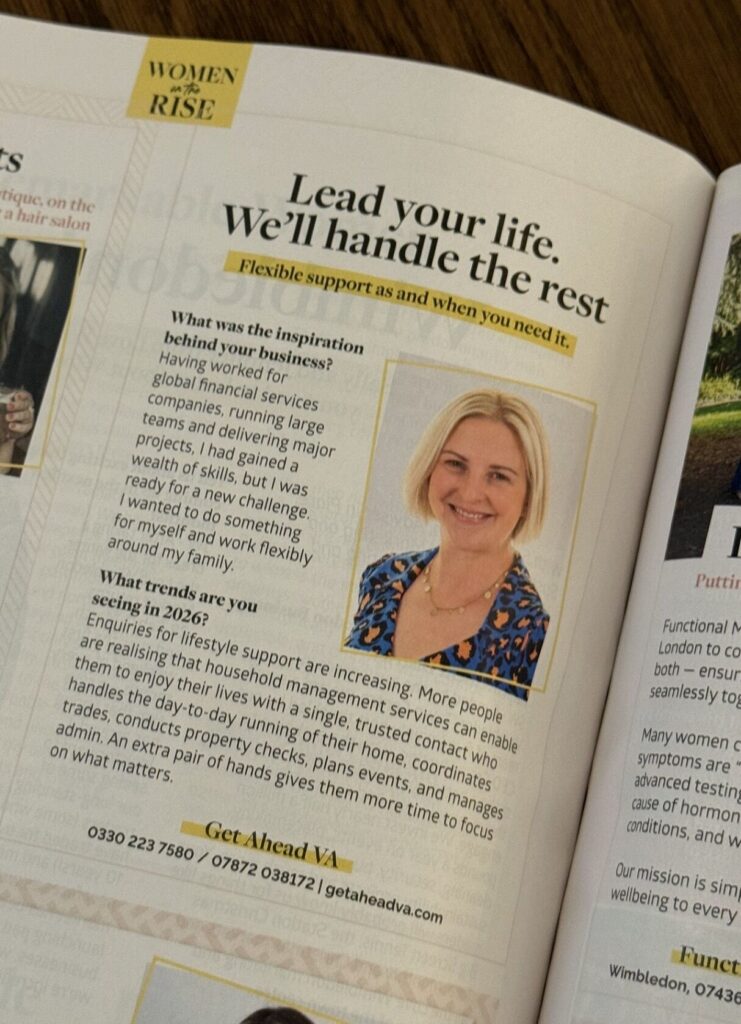
Lifestyle Manager Services: Support for Busy Households and Families

For many busy professionals, there comes a point when the logistics of running a home start to compete with everything else.

Careers are demanding. Family life is full. Weekends disappear into lists of things that need organising; suppliers to call, deliveries to coordinate, properties to check, plans to arrange.

None of these things is particularly difficult. But together, they take time, attention and mental energy.

That’s the moment when many people start to ask a simple question:

“Is there someone who could just take care of this for me?”

At Get Ahead, we’ve been hearing this question more and more from clients and contacts, people who are successful in their careers but simply don’t have the time or desire to manage every practical detail of their home and lifestyle.

That’s why we’ve launched our new Lifestyle Manager service, designed to provide trusted support with the practical logistics that keep a home and family life running smoothly.

A Trusted Partner for the Practical Details

Our Lifestyle Manager service provides a single, trusted point of contact to oversee the practical details that sit outside the workplace but still need to run smoothly.

That might include:

  • Coordinating trades and household suppliers
  • Arranging property checks when you’re travelling
  • Preparing your home for guests or returning from a trip
  • Managing deliveries, access and logistics
  • Organising special occasions or family gatherings

In short, it’s about making sure the things that need to happen in the background actually happen, reliably, professionally and without you having to think about them.

Supporting Busy Family Lives

For many people, this stage of life also comes with an additional layer of responsibility.

They’re supporting children with increasingly busy lives, while also helping ageing parents who may need a little more practical coordination and support.

This stage of life is often described as the sandwich generation, balancing the needs of two generations while managing demanding careers and households of their own. Many professionals recognise this picture: work commitments, children’s activities and supporting ageing parents, all while trying to keep the practical details of their own homes running smoothly.

Having a trusted person who can quietly take care of some of the day-to-day logistics can make a real difference.

That’s exactly what our Lifestyle Manager service is designed to provide.

Professional Support, Delivered the Get Ahead Way

One of the things that makes this service different is that it’s delivered as part of the Get Ahead network.

For years, Get Ahead has supported businesses with flexible access to experienced professionals across areas such as marketing, HR, operations and administration. Clients trust us because of the quality of the people behind the service.

Our Lifestyle Manager offering builds on that same approach.

You gain a dedicated, trusted partner, supported by the wider Get Ahead team when additional expertise is needed.

It’s discreet, dependable support, designed to make life easier.

More Time for the Things That Matter

Ultimately, this service exists for one reason: to give people time back.

Time to focus on work when work is demanding.
Time to spend with family and friends.
Time to enjoy your home rather than manage it.

As we like to say:

Lead your life. We’ll handle the rest.

Or put another way:

The staff you don’t see. The difference you do.

Curious Whether This Could Help?

Many people only start exploring this kind of support when things feel particularly busy or stretched.

But often the biggest benefit comes from having trusted help in place before things reach that point.

If you’d like to understand how the Lifestyle Manager service works, or simply explore whether it might be useful for your household, I’d be very happy to have an informal conversation. You can book a call with me using this link, or email me at natasha.doran@getaheadva.com. I look forward to speaking with you.

And a final thank-you to Time & Leisure Magazine, which recently featured this piece. It was lovely to see it in print for the first time.

Why It Makes No Commercial Sense for Directors to Do Their Own Admin (And When to Change That) 

There is a consistent pattern. The business scales. Revenue increases. The board formalises. Governance expectations rise.

And yet directors are still managing their own diaries. Formatting board packs late in the evening. Chasing actions. Rebooking travel. Clearing inboxes. Updating operational spreadsheets.

Not because they lack support. And not because it is required at their level. More often, it is because in the moment it simply feels efficient to “just do it myself”. Over time, it has quietly become the default.

But at a certain stage of growth, that approach stops making commercial sense.

What Is Board-Level Administrative Support?

Board-level administrative support is structured operational assistance that enables directors to focus on strategic decision-making rather than diary management, document preparation or governance tracking.

It is not simply PA support. It is about protecting leadership capacity and strengthening governance processes as businesses mature.

In SMEs approaching or exceeding £10m turnover, the cost of misallocated leadership time becomes increasingly significant.

Should Directors Do Their Own Admin?

Directors are perfectly capable of managing their own administration. The real question is whether it represents the highest commercial return on their time.

A director in a £15m business may cost the organisation £70–£80 per hour once salary and overheads are included. If five hours a week is absorbed by administrative activity, that equates to nearly £20,000 per year – time not spent on strategy, growth or governance.

That is not a criticism. It is arithmetic.

Beyond the cost, there is emerging research showing that many boards today are not positioned to add maximum value. Recent UK analysis of boardroom effectiveness found that only one-third of board directors believe their board is essential to value creation, with many boards focused disproportionately on backwards-looking reporting rather than forward-thinking strategy and growth planning.

This highlights a deeper issue: if boards are structured in a way that limits strategic focus, any diversion of director time into operational tasks compounds that constraint. In growing businesses, leadership time is one of the most expensive and scarce resources available. How it is deployed matters.

The Hidden Cost: Opportunity, Not Efficiency

The greater risk is not the hourly cost. It is the opportunity cost of time lost for reflection, thinking and strategy.

Industry insight suggests that directors are increasingly overwhelmed with information and under-prepared for meetings, in part because boards are not set up effectively and directors are expected to absorb huge volumes of operational detail.

This overload makes it harder to engage deeply with strategic priorities, especially in leaner organisations where external executive support is not yet formalised.

In a £15m business, a 1% margin shift represents £150,000. Even modest improvements in strategic clarity can outweigh the cost of structured support many times over.

The risk is not that directors cannot do their own admin.
The risk is that they are.

When Should a Business Formalise Board Support?

There is no single turnover trigger. But there are warning signs:

  • Board meetings are dominated by operational detail
  • Directors regularly prepare board materials outside working hours
  • Governance documentation lacks structure
  • Follow-up actions are inconsistent

These are not failures. They are growth signals.

As organisations mature, informal systems that worked at £3m rarely sustain £15m.

Protecting leadership capacity is a sign of organisational maturity, not extravagance.

What Effective Board Support Looks Like in Practice

Board-level support typically includes:

  • Coordinating structured board agendas
  • Preparing coherent, accurate board packs
  • Tracking decisions and actions
  • Managing governance documentation
  • Aligning director diaries with strategic priorities
  • Ensuring follow-up is completed between meetings

In one of our larger SME clients, providing consistent support to the Commercial Director has released meaningful leadership capacity back into revenue-driving activity. Preparation is sharper. Follow-up is tighter. Strategic focus has improved.

The change was not dramatic. But it was material.

Governance Is Ultimately a Capacity Question

Board effectiveness is not just about who sits around the table.

It is about whether those individuals have the time and clarity to exercise sound judgement.

In growing SMEs, directors often remain highly operational long after the business has outgrown that model.

Supporting directors operationally does not dilute their involvement. It enables better oversight, stronger governance and more considered commercial decisions.

It moves leadership time back to where it has the greatest impact.

In Summary

  • Director time is one of the most valuable resources in a growing SME.
  • Administrative activity carries a measurable financial and strategic cost.
  • Structured board support improves governance and commercial focus.
  • Protecting leadership capacity signals organisational maturity.

If you sit on the board of a scaling business, it may be worth asking one simple question:

Are you spending your time where it delivers the highest commercial return?

Because capability is rarely the issue.

Capacity often is.

Great on paper. Risky in reality.

Partner marketing rebates can look like guaranteed income. In practice, they are one of the easiest revenue streams for businesses to lose.

For IT resellers, payments providers, wholesalers and other partnership-led businesses, rebate income is almost always conditional. Campaigns must be delivered to agreed specifications, within fixed timeframes, and supported by clear evidence. If any part of that process breaks down, rebate income can be delayed or lost entirely.

What is a partner marketing rebate?

A partner marketing rebate (often funded through Marketing Development Funds (MDF)) is a financial incentive offered by vendors to partners, resellers or distributors.

In return for delivering agreed marketing activity, such as digital campaigns, content, or events, the partner can claim back part or all of the campaign cost.

Rebates are not automatic. They typically depend on:

  • Campaigns being delivered exactly as agreed
  • Activity running within defined dates
  • Evidence being submitted in the correct format
  • Reporting being completed on time

If these conditions are not met, the rebate may be reduced, delayed, or rejected.

Why partner marketing rebates are riskier than they appear

On paper, partner rebates look straightforward. In reality, they introduce several operational risks.

Common risk factors include:

  • Fixed deadlines tied to quarter or year-end
  • Detailed and sometimes inconsistent evidence requirements
  • Multiple stakeholders across marketing, sales and finance
  • Competing priorities within internal marketing teams

Partner campaigns are often treated as “additional” work rather than revenue-critical activity, increasing the likelihood that delivery or evidence will slip.

What typically goes wrong with partner marketing rebates

In practice, partner marketing rebates are most often lost or delayed for the same reasons:

  • Campaigns are launched too late to meet deadlines
  • Evidence is gathered retrospectively rather than during delivery
  • Screenshots, links and reports are stored inconsistently
  • Ownership of rebate claims is unclear
  • Marketing teams are under pressure at peak periods

When even one requirement is missed, the entire rebate claim can be invalidated, even if the campaign itself ran.

The hidden cost of missed partner marketing obligations

The impact of a missed rebate is not just administrative.

Lost or delayed rebate income can result in:

  • Reduced profitability from partner relationships
  • Lower return on marketing investment
  • Tension between marketing, finance and commercial teams
  • Increased stress and last-minute pressure at quarter-end

Because rebate income is often high-margin revenue, losing it has a disproportionate impact on the bottom line.

How businesses can reduce partner marketing rebate risk

Businesses that consistently secure partner rebates take a more disciplined approach to partner marketing.

Effective approaches include:

  1. Treating partner marketing as revenue-critical, not optional
  2. Planning evidence requirements before campaigns launch
  3. Capturing proof as activity happens, not retrospectively
  4. Assigning clear ownership for delivery and reporting
  5. Adding flexible capacity at quarter- and year-end pressure points

Many organisations also bring in specialist partner marketing support to ensure campaigns are delivered correctly and evidence is captured in real time.

Proof in practice: reducing quarter-end pressure and scaling delivery

Lisa, Regional Director at Get Ahead, works closely with businesses running multiple partner and MDF campaigns. She sees quarter-end pressure as one of the biggest risk factors for missed or delayed rebate income.

“We streamline partner digital marketing activity to remove quarter-end pressure from the in-house marketing team.”

Why this matters:
When pressure builds at quarter-end, delivery quality and evidence capture are often the first things to suffer. Removing that pressure significantly reduces the risk of campaigns slipping or rebate claims being rejected.

Client perspective: XMA

XMA is a large UK IT solutions and services provider managing a high volume of partner-led digital campaigns across multiple vendors.

“We work with Get Ahead in a flexible capacity and the value that flexibility brings has been invaluable to our marketing team. Their support on partner-led digital campaigns has helped us scale activity quickly without adding internal overhead. They understand our brand, our vendors, and the pace we operate at and work seamlessly within our existing processes as an extension of our in-house team. From planning and execution through optimisation, their digital campaign support is consistently reliable, effective, and easy to work with.”

Flexible, on-demand partner marketing support allows teams to scale activity, meet partner requirements, and protect rebate income without increasing permanent headcount.

When partner marketing support makes sense

External support is most valuable when:

  • Internal teams are stretched or at capacity
  • Multiple partner campaigns run simultaneously
  • Deadlines cluster at quarter- or year-end
  • Rebate income is commercially significant

In these situations, the cost of additional support is often outweighed by the revenue it helps protect.

Partner marketing rebate FAQs

Are partner marketing rebates guaranteed?
No. Rebates are conditional on delivery, timing and evidence. Even small gaps can affect payment.

What happens if a campaign misses the deadline?
In many cases, missing a deadline can invalidate the entire rebate claim.

Who is responsible for evidencing partner campaigns?
Responsibility should be clearly defined, but in practice this is often where problems arise.

Can rebate income be delayed even if campaigns run?
Yes. Delays in submitting evidence or reporting can delay payments by weeks or months.

In summary

Partner marketing rebates can deliver valuable income, but only when campaigns are delivered properly and evidenced correctly.

Capacity gaps, unclear ownership and quarter-end pressure are the most common reasons rebate income is lost. Businesses that plan for these risks and allocate resources accordingly are far more likely to secure the revenue their partnerships promise.

If you’d like to firm up your rebates, you can read more here or contact us today to find out more. 

Partner marketing rebates often look like guaranteed income. In reality, they are one of the easiest revenue streams to lose. 

Marketing Development Funds (MDF) give partners access to funding for impactful marketing, reduced costs , rebates and increased sales opportunities but campaigns must be delivered to strict guidelines, within tight deadlines, and supported by clear evidence. Miss any part of the process and the rebate may be delayed or lost entirely. 

Why rebate income is at risk 

Internal marketing teams are under constant pressure. Marketing development fund campaigns are rarely the only priority and often compete with: 

  • Product launches 
  • Sales support 
  • Employer branding 
  • BAU digital activity 

As quarter- or year-end approaches, multiple partner deadlines converge. Campaigns get rushed, evidence is gathered retrospectively, and reporting becomes inconsistent. 

The result isn’t just marketing stress, it’s commercial risk

The hidden cost of missed obligations 

When partner campaigns slip, businesses can face: 

  • Lost or delayed rebate payments 
  • Reduced ROI on partnership relationships 
  • Strain between marketing, sales and finance teams 

What’s often overlooked is that rebate income is usually high-margin revenue. Losing it has a disproportionate impact on profit. 

A smarter way to protect rebates 

Many partnership-led businesses now use flexible specialist marketing support to step in at pressure points. This ensures: 

  • Campaigns are delivered to partner specifications 
  • Evidence is captured as activity happens 
  • Deadlines are met without burning out internal teams 

The cost of support is frequently outweighed by the rebate income it protects. 

If partner rebates matter to your bottom line, protecting delivery is not optional. It’s essential. 

As our Regional Director Lisa Middleton says, ” We streamline partner digital marketing activity to remove quarter-end pressure from the in-house marketing team.”

If you’d like to firm up your rebates, you can read more here or contact us today to find out more. 

When a marketing lead leaves, the instinctive response is to find a replacement quickly. Businesses want continuity and minimal disruption. 

But replacing a person doesn’t always solve the problem. 

The questions many teams avoid 

A departure often exposes uncertainty: 

  • What marketing activity is actually driving results? 
  • Which skills are missing? 
  • Has the business outgrown the role? 

Hiring like-for-like can embed the same issues for another year or more. 

Why a short pause creates better outcomes 

Short-term expert support during transition allows businesses to: 

  • Review performance objectively 
  • Identify real skill gaps 
  • Clarify priorities before recruiting 

This approach reduces the risk of expensive mis-hires and misaligned marketing strategies. 

Clarity before commitment 

Taking time to reset doesn’t slow growth, it enables it. 

The strongest marketing teams are built intentionally, not reactively. 

Our Regional Director Lisa Middleton points out that “transitions are an opportunity. Short-term expertise gives leaders the insight they need to design the right marketing role, rather than inheriting yesterday’s structure.” 

If a reset sounds sensible, you can read more here or contact us today to find out more. 

Marketing budgets are under more scrutiny than ever. Every decision must be justified, and every campaign must show potential value. 

Yet many businesses still commit significant spend before they know whether a campaign, market or audience will deliver results. 

Why big bets are risky 

Launching into a new sector, geography or product without testing often leads to: 

  • Wasted budget 
  • Slow learning 
  • Internal scepticism when results disappoint 

When budgets are tight, mistakes are expensive. 

The power of controlled testing 

“Test before you invest” marketing focuses on learning first, scaling second

Small, controlled campaigns, often in the £500 to £1,500 range, are designed to answer critical questions: 

  • Is there genuine demand? 
  • Which messages resonate? 
  • Which audiences engage? 

These tests provide evidence, not guesswork. 

Better insight, better decisions 

Testing allows businesses to: 

  • Reduce wasted spend 
  • Build confidence before scaling 
  • Make informed investment decisions 
  • Focus resources where they will have the most impact 

In uncertain markets, certainty is a competitive advantage. 

As our Regional Director, Lisa Middleton says, “it’s much easier to back a marketing decision when you’ve already seen proof it works. Testing gives leaders campaign clarity before they commit serious budget.”

If you’d like to test us first, you can read more here or contact us today to find out more.

Many leaders can list what their marketer does. Far fewer can explain which activities directly support growth. 

When clarity is missing, recruitment becomes guesswork. 

Activity vs impact 

Marketing output is easy to see: 

  • Social posts 
  • Campaigns 
  • Content 

Marketing impact is harder to measure without proper review. 

Using change as an opportunity 

Periods of change allow businesses to: 

  • Rebuild marketing around outcomes 
  • Align skills to growth goals 
  • Improve ROI from limited budgets 

The result is not just a better hire but a more effective marketing function. 

If this touches a nerve, you can read more here or contact us today to find out more. 

Many SMEs use inboxes, ad-hoc notes or even try to rely on their memory to track holidays, sickness or employee details, and that’s when problems start. 

But a simple HR tracker can dramatically improve your admin, compliance and employee experience. 

Why a tracker matters 

1. No more searching through emails 

Everything is recorded in one place. 

2. Prevents mistakes 

Double-booked holidays, missed probation reviews, forgotten training dates… 

3. Supports better conversations 

Clear data means better discussions around performance, attendance or wellbeing. 

4. Shows patterns early 

Spotting trends early helps you manage issues proactively. 

5. Makes you look (and feel) more professional 

Employees appreciate organised systems. 

What should be included? 

A good tracker should include: 

  • Holiday balances 
  • Sickness & absence 
  • Start dates 
  • End-of-probation dates 
  • Training 
  • Appraisals 
  • Next-of-kin information 

You’ll find all of this in the template included in the HR Confidence package. 

Want a tracker that’s ready to use? 

Explore HR Confidence