In this series I have written about the planning that gets skipped at the start, and the accountability that drifts once a project is underway. This time I want to focus on the end, or rather, what happens when a project does not quite get there, and what is lost when it does not.

The statistics are stark

The data on project outcomes is not reassuring. Research by the Project Management Institute found that only around 29% of projects are completed on time and within budget. The Standish CHAOS Report, which has tracked project outcomes for decades, consistently finds that fewer than a third of projects are considered fully successful.

A separate PwC study of more than 10,000 projects found that only 2.5% of organisations complete all of their projects successfully.

These figures are drawn largely from larger organisations with dedicated project management capability. The picture in smaller businesses, where projects tend to be less formally managed, is unlikely to be more encouraging.

Most projects, in most organisations, do not fully deliver what they set out to do.

Why projects stall in the final stretch

The halfway point of a project is where the energy peaks. The initial excitement is still present, some progress is visible, and the end feels close enough to motivate.

But the final third is harder. The interesting, creative work is largely done. What remains is often the detailed, painstaking work of implementation: testing, training, communication, process embedding, and the thousand small tasks that turn a project output into something the business can actually use.

This is also the point at which the business, having waited patiently for the project to deliver, starts to expect results. Pressure builds. People who have been borrowed from their day jobs want to return to them. Sponsors who have been funding the work want to see a return.

And so, more often than not, the project is declared done before it is finished. A system goes live without proper training. A new process is documented but not embedded. A change is announced but not followed through.

Finishing is not the same as succeeding

This is the distinction that project management theory calls benefits realisation, and it is the phase that most organisations handle least well.

A project is not successful because it was delivered on time and within budget. It is successful because the change it was designed to create actually happened, and the business is genuinely better as a result.

If a new CRM system goes live but the sales team does not adopt it, the project has not succeeded. If a new process is designed but not followed, the project has not succeeded. If a restructure is completed on paper but the working patterns and relationships do not change, the project has not succeeded.

Benefits realisation is the work of making sure the change actually lands. It is unglamorous, it is slow, and it requires sustained attention after the moment of launch when everyone’s focus has already moved on. Which is precisely why it so often does not happen.

Why this matters more in growing businesses

In a large organisation, a project team might stay in place for months after go-live to support adoption, manage issues, and track whether the intended benefits are being realised. There are often formal review points, benefit tracking mechanisms, and governance structures that persist beyond delivery.

In a growing business, the project team is usually the senior leadership team, plus whoever else could be spared. When the project is declared done, everyone returns to their day jobs immediately. The headspace that was devoted to the project disappears almost overnight.

And so the final 10% of the work, the embedding, the adoption, the measurement, gets quietly abandoned. The project is considered finished. The benefits are assumed rather than tracked. And six months later, when someone asks whether things have changed, the honest answer is: not as much as we expected.

Asking the question at the start

The most effective way to improve benefits realisation is to define what it looks like before the project begins.

What does success look like, specifically, 90 days after go-live? What behaviours will have changed? What metrics will have moved? Who is responsible for tracking that, and what happens if it is not happening?

These questions are uncomfortable to answer before the project has started, because the honest answer is often: we do not know yet. But the act of asking them forces a clarity about purpose that makes everything that follows more deliberate.

A project with a clear definition of the change it is trying to create is more likely to get to the end. And a project team that knows it will be asked to demonstrate benefits is more likely to plan for the work of realising them.

The question worth asking

Before the next project begins, it is worth asking a simple question: if we get to the end and declare this done, how will we know whether it actually worked?

If the answer is uncertain, that uncertainty is worth resolving before the project starts, not after it finishes.

The cost of a project that delivers without landing is not just the budget and the time. It is the opportunity cost of change that did not happen, and the organisational fatigue of going through the process of change without receiving its benefits.

That is an expensive outcome. And in most cases, it is a preventable one.

If you are planning a project and want to think through how you will know whether it has truly succeeded, or if you are partway through one and wondering whether the benefits are being properly tracked, I am always happy to have that conversation.

Get Ahead’s team works across the full range of project support, from planning and coordination to delivery and benefits tracking.

Get in touch: fiona@getaheadva.com   |   Explore our support: getaheadva.com


The Operational Edge, Post 4 of 4

I did not set out to build a career in event management. I came from a corporate background in HR and performance, and event planning arrived through the side door: initially something I took on because it needed doing, and gradually something I became good at and sought out.

What I did not expect was how much the discipline of running complex events would teach me about business. Not about events specifically, but about the kind of operational and commercial thinking that underpins any well-run organisation.

This is the final post in a series built around that premise. Not as a neat argument constructed after the fact, but as something I have come to understand through the work itself.

The information timing insight

The most transferable thing event work taught me is deceptively simple: people cannot act on information before they are ready to act on it.

In an events context, this is practical and immediate. Send a delegate their travel details three months before the event and they will not know where to find them when they need them. Send them two weeks before and they will use them. The information is identical. The timing is what changes the outcome.

I apply the same thinking to how I communicate with clients. Not everything needs to be shared immediately. Some things are better held until the moment when they are actually useful. The discipline is knowing the difference, and resisting the temptation to communicate for the sake of it.

What joined-up support actually looks like

One of the things event work made concrete for me is what it means to bring different kinds of expertise together for a single outcome.

An event needs copy written. It needs a logo and a landing page and printed materials. It needs someone to manage registrations, liaise with the venue, brief the AV team, and be on-site when the day comes. None of those things requires the same person. All of them need to work together.

For a client without an internal marketing team, I might pull in three hours of a graphic designer’s time for the branding, write the copy myself, manage the registrations, and bring in additional support on the day. The client gets a complete service without employing anyone permanently. They pay for what they need, when they need it.

That is also, precisely, how Get Ahead works. The model was not new to me because I had already been living a version of it. What Get Ahead provides is the structure, the network, and the matching process that makes it work across a much wider range of business needs than events alone.

What reputation actually builds

My current event clients did not find me through advertising. They found me because someone they trusted had worked with me and recommended me. Several of them were delegates at events I ran for other clients, who subsequently asked me to run events for their own organisations.

Reputation in that sense is not something you manufacture. It is the cumulative result of doing the work carefully, repeatedly, and without making clients feel the effort behind it.

I think about that when I work with businesses through Get Ahead. The support I provide is not visible to their clients. It is not supposed to be. What is visible is the effect: a business owner who is calmer, better prepared, and more present than they would be if they were trying to carry everything themselves.

Why I do this work

I am sometimes asked what the connection is between a corporate HR career, years of running scientific conferences, and being a Regional Director for a business support network.

The honest answer is that they are all versions of the same thing. Understanding what a person or organisation needs to perform well. Building the conditions that make that possible. Getting out of the way when it is working.

The businesses I support through Get Ahead are run by people who are good at what they do. They do not need me to do it for them. They need the operational breathing room to do it better, and the confidence that comes from having the right support in the right place at the right time.

That is what this series has been about: not event management for its own sake, but what the discipline of running complex operations under pressure teaches you about running anything well.

If any of it has resonated, I would be glad to have a conversation. Not a pitch. Just a conversation about where your business is right now, and whether the kind of support I provide through Get Ahead could make a useful difference.


The event planning and debrief framework from Post 3 is available to download at [link].

The three other blogs in this series are:


About the Author

Read more about Suzanne here.


One Year In: Natasha Doran on Building the East Surrey and West Sussex Region 

A year ago this month, Natasha Doran launched as Get Ahead’s Regional Director for East Surrey and West Sussex. Twelve months on, she has built a genuine local network from scratch, taken on clients ranging from sole traders to scaling businesses, and become one of the region’s most visible faces at local networking events. To mark her first anniversary, she sat down with Get Ahead Founder Rebecca Newenham to talk through the year: what she expected, what surprised her, and where the region goes from here. 

A change she couldn’t quite plan for 

Natasha left her corporate career around eighteen months before joining Get Ahead, without a fixed plan for what came next. She knew she wanted something different and spent the first few months exploring contract roles that, on closer inspection, looked a lot like the job she had just left. She also completed a coaching qualification she had wanted to do for years, a qualification she still values, though it became clear it suited a role on the side rather than the whole of her working week. 

Get Ahead, meanwhile, kept turning up. “You seem to pop up everywhere on my social media, my LinkedIn,” she told Rebecca, describing what felt at the time more like a coincidence than a plan. A first conversation turned into a series of them over several months. “Within about the first fifteen minutes of us chatting, I was thinking, oh my goodness, this could actually be exactly what I’m looking for.” 

With three young children and a summer of family holidays ahead, Natasha took her time before committing, and joined as Regional Director in September 2025, a start date she had always liked the feel of. The lead-in mattered. Rather than a single handover, the relationship built gradually over several calls, so that by the time she formally started, little felt unfamiliar. 

A mentor and a fast start 

One early surprise was being paired with a mentor, fellow Regional Director Kristy Roff, for the first stretch of the role. “That was such a lovely surprise, having somebody that I can just text.” Natasha says. The support proved useful almost immediately: her first enquiry came in within the first week, through a friendly referral, with Kristy helping her put together her first client proposal from a standing start. 

“I thought the first three months would just be planning and we’d get going in January. Actually, with the events we set up and the contacts I had, it was able to get going pretty quickly.” 

That early momentum set the tone. Natasha was, by her own account, receptive to attending anything, travelling well beyond her immediate local area to build a presence rather than treating her region as a fixed patch. The approach paid off in a faster foothold in the local business community than a narrower strategy would have allowed. 

Finding her own approach to networking 

Early on, Natasha gravitated toward informal, conversational networking events over anything more structured, in part because standing up and pitching yourself to a room is, as she puts it, alien to most people, let alone someone starting out in a new venture. Over the first three months she worked out which events genuinely suited her and which didn’t, a process she now sees as just as valuable as the connections themselves. 

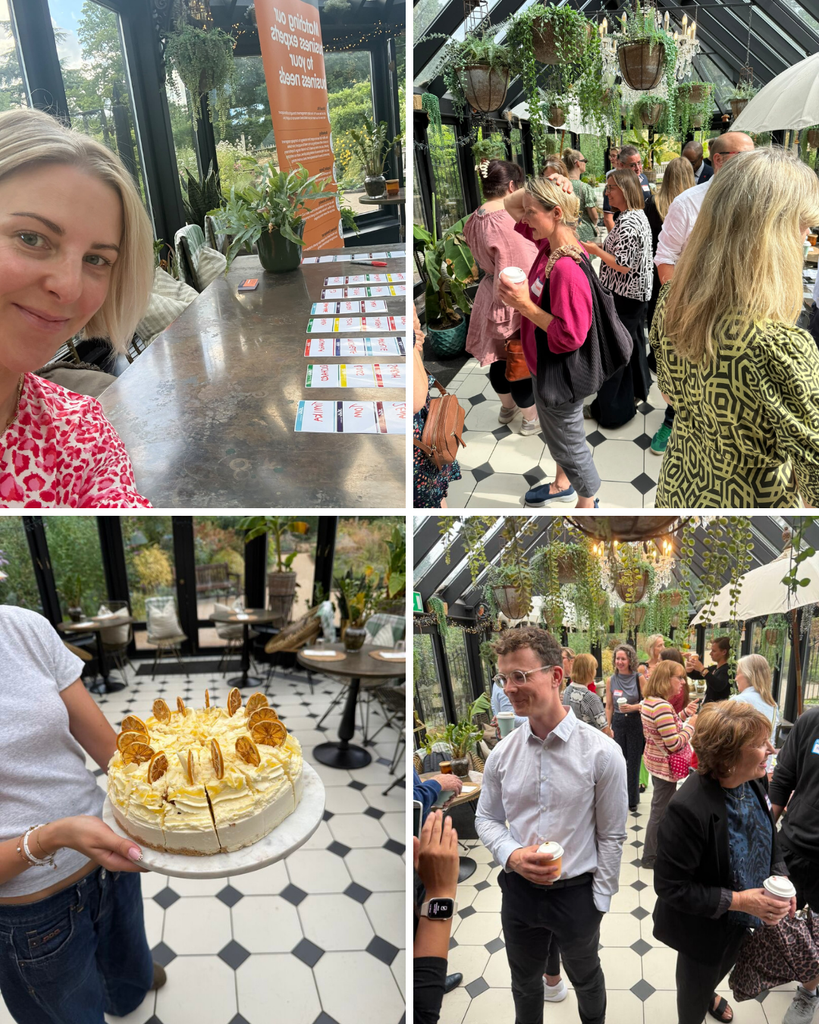
She has since gone on to host her own events, including a regular gathering in Horsham, something she admits she once dreaded the idea of. “Even though that filled me with dread, it’s probably one of the things I’ve enjoyed the most.” Rebecca points to the deliberate care Natasha takes with every attendee, making sure each person is introduced and made welcome, as a large part of why the events work: some people who would never attend a typical networking event come along to hers. 

Natasha also brings a degree of strategy to how she covers her region day to day, mentally dividing it into four areas and making sure she’s engaging with each, whether through events, LinkedIn activity, or simply staying visible to existing connections, rather than concentrating only on the geographically largest patch. 

The clients: a warm introduction and a summer rescue 

Several of Natasha’s early clients came through indirect routes rather than direct pitches. One came from a sales director who attended her regular networking meetings and later passed on a warm introduction when his own HR director needed sales support. Another arrived centrally through Get Ahead’s head office, a relationship that has since grown from initial VA support into marketing work as well. 

The story Natasha returns to in most depth is a client whose business had scaled quickly after a business partner stepped away, leaving him managing far more than he had planned for. Get Ahead placed a VA with him, who has now been working with the client for around seven months, followed by a social media manager. When a separately recruited business development hire fell through just before a planned holiday, he came to Natasha in what she describes as “a bit of a frantic panic”. 

“Being a parent and a wife myself, the one thing you can’t do is cancel that holiday. So being able to work with somebody from our team who was around for six weeks, full time, was just really lovely.” 

It’s the kind of gap that would have been difficult to fill during peak summer holiday season without the wider Get Ahead network behind her, and Natasha points to it as one of the clearest examples of what the model offers clients that going it alone couldn’t. 

What the wider network has meant 

Asked what has made the biggest difference to her first year, Natasha comes back repeatedly to the depth of the wider Get Ahead team, somewhere between eighty five and ninety people working across the network. “I would never be able to put that together with just my own two or three people. Having true specialists, true experts, has been amazing.” 

She also points to the practical, day to day support: a place to check quick questions the way she would with a colleague in an office, proposal templates that saved her weeks when she was starting out, and a genuinely collaborative culture among Regional Directors doing similar roles across different regions. “Everyone genuinely wants people to do the best they possibly can. Having the regions split out has really helped that.” 

Looking ahead 

A year on, Natasha sees the foundations of her region as largely in place: a settled calendar of events she attends and hosts, and a growing base of client relationships. She describes the next phase as a potential springboard, with particular interest from slightly larger businesses who aren’t yet ready to bring on a permanent member of staff, an opportunity she is now thinking about how to tailor for. 

Asked what she would tell herself on day one, her answer is networking itself. “I thought that was something I was just going to have to smile and get on with. Never in a million years did I think I’d be actively putting myself forward to run events and think about where we can start new ones.” 

Rebecca’s closing reflection: “Thank you for sharing your journey. I can’t wait to be doing this again in a year’s time and seeing where you’re at then.” 

Link Up Horsham
Birthday Celebrations

You can read more about Natasha here. And to learn more about the Get Ahead franchise opportunity please click here.


About the Author

Improving organisational performance is not about chasing a single metric or introducing more short-term initiatives. Clear and sustainable progress comes from aligning people, strategy and processes so that everyone understands what matters, has the support to deliver, and sees how their work contributes to the organisation’s wider goals. When these elements reinforce one another, businesses are better placed to improve productivity. We believe in the following (and can help you to achieve them!)

1. Agree on clear, shared goals

People are more likely to do their best work when everyone has a clear picture of what success looks like. Turn the organisation’s strategy into a small set of practical priorities, then work together to connect them to team and individual objectives. From the start, agree how progress will be measured and who will take the lead on each area. Regular check-ins create space to tackle obstacles early and gives your people the context and confidence they need to make good decisions.

2. Empower and support your people

Employees perform at their best when they have clear expectations with the right tools and genuine ownership of their work. The freedom to perform to the best of their ability is a gift to a valued employee! Managers thrive with the skills to coach rather than simply direct and they may need training to do so. It’s rewarding to encourage employees to raise ideas and challenges freely and without barriers. 

3. Make the best of communication 

Effective communication is a two-way flow, not just a stream of announcements. At Get Ahead, we believe that communicating decisions clearly and explaining the reasons behind change helps employees feel informed, involved, and confident about how to respond. We can help you to do the same. There is a valuable variety of channels for all of us to use including Microsoft Teams, Slack and sharing ideas in Google Drive. 

4. Simplify processes and measure what matters

Even highly capable teams are slowed by unclear responsibilities and outdated systems. It pays to stick with processes that have the greatest effect on customers and employees. It may help to read our recent article on how to eliminate repetitive tasks to see how to leverage automation to help improve performance. There are some great pointers on how to communicate effectively too. All designed to help your business grow!

5. Create a positive and supportive workplace culture

Culture grows best through everyday actions and a shared sense of purpose. We encourage organisations and leaders to help by modelling the behaviours they would like to see, responding to concerns fairly and consistently, and creating an environment where people feel comfortable in speaking up. By encouraging teams to work together, a business can create a positive culture that builds the trust and shared responsibility to help change take root and last.

6. Turn intention into action

We recommend starting with one performance challenge that matters to your organisation. Choose what this is and define the outcome, speak to the people closest to the work and agree a small set of actions. From there, the whole team can review progress on an agreed date. This focused approach creates momentum and makes it easier to scale what works. Performing as a team and talking about what went right and what could be improved establishes fundamental building blocks to make your business a success.

Get Ahead connects organisations with experienced UK-based experts who can provide flexible, practical support across people, operations, communication and business improvement. Whether you need specialist input for a defined project or ongoing support, we help you access the right expertise to move forward with confidence.