In a World of Artificial Intelligence, Human Connection Still Wins the Buying Decision

AI is transforming how businesses automate marketing, customer service and operations. Online โ€˜chatbotsโ€™ can answer questions instantly, booking systems automate entire customer journeys, and algorithms increasingly anticipate what customers โ€˜mightโ€™ want before they even ask.

For many businesses, this is a huge step forward. Efficiency matters. Speed matters. Convenience absolutely matters.

At Get Ahead, we embrace technology where it genuinely adds value.

But in conversations with business owners every week, one thing remains consistently true:

People still want people.

Automation can deliver information quickly, but when decisions become important or complex, buyers still look for reassurance, interpretation and human guidance.

Why Human Connection Still Matters in an AI-Driven Business World

Artificial intelligence can streamline many parts of the buying journey, but it has not changed the psychology behind decision-making.

Buying decisions remain fundamentally human.

Even in B2B environments. Even at board level. Even when budgets are under scrutiny.

Customers still ask themselves questions like:

  • Do these people understand my situation?
  • Do they genuinely understand my business?
  • Can I trust their advice?
  • Will someone guide me if things change?

Technology provides information. People provide interpretation and reassurance.

That distinction matters more than many businesses realise, as it creates confidence

When the Buying Journey Quietly Stalls

Have you ever abandoned a booking because you couldnโ€™t ask the question you actually needed answered?

Perhaps it was a restaurant reservation. You wanted to check something specific, dietary requirements, accessibility, a quieter table, or arrangements for a special occasion.

Instead, you were directed to:

  • an automated booking system
  • a chatbot with limited responses
  • or a FAQ page that didnโ€™t quite address your situation

So, you paused.

You hesitated.

And often, the booking never happened.

That moment is incredibly important in the buying process.

Itโ€™s not necessarily that the system is bad. Itโ€™s that reassurance, clarity and therefore confidence is missing.

Automation speeds processes, but human guidance speeds decisions.

The Hidden Drop-Off in the Sales Process

In discussions with SME leaders, one recurring theme appears: prospects quietly drop out of the buying cycle.

Not because the service is wrong. Not because the price is unacceptable.

But because they donโ€™t feel confident making the decision.

They may feel:

  • unsure about what level of support they need
  • uncertain whether the solution fits their business
  • worried about making the wrong choice

So they pause.

And in business, hesitation is expensive.

Many sales cycles stall not because of price, but because buyers lack confidence in the decision.

In a world of automation, the gap isnโ€™t information.

The gap is interpretation.

How Businesses Should Combine AI and Human Expertise

For growing SMEs, the real question is not whether to use AI or human support.

The most effective organisations combine both.

AI can help businesses:

  • process information quickly
  • automate routine tasks
  • improve operational efficiency
  • scale marketing and customer service

Human expertise, however, remains essential for:

  • interpreting complex situations
  • building trust and relationships through authenticity
  • guiding strategic decisions
  • providing reassurance during change

The strongest organisations combine intelligent systems with human judgement.

Where a Regional Director Adds Value

As a Regional Director at Get Ahead, my role is not simply to sell a service.

My role is to guide a decision.

Often, a business owner initially believes they need one specific type of support, perhaps marketing assistance or administrative help.

But after a deeper conversation, the real pressure point may be something different:

  • operational capacity challenges
  • inconsistent internal processes
  • HR foundations that need strengthening

There is rarely an off-the-shelf answer. There is conversation. There is context. There is nuance.

A Regional Director helps business owners:

  • understand their operational pressure points
  • identify the right expertise for their stage of growth
  • match the right Virtual Expert to the role
  • guide the process from first conversation to confident decision

The role of a Regional Director is to translate complexity into clear, confident next steps.

AI may help shortlist options.

But it cannot sit across the table and explain why one option truly fits a business better than another.

The Human Side of Growth

This article is the first in a short series exploring the human side of business growth.

Future articles will look at:

  • why community plays a powerful role in business success
  • why bespoke support often outperforms generic solutions
  • why leaders need the right people around them as their businesses evolve

Technology will continue to evolve, and it should.

But the businesses that stand out will be those that combine efficient systems with genuine human connection.

AI may be leading the way.

But people still close the deal.

If you’re reviewing how automation, AI or outsourced expertise could support your business growth, Iโ€™m always happy to have a conversation. You can reach me via kristy@getaheadva.com or book in a chat –ย  Calendly – Kristy Roff

No hard sell.

Just clarity.

Key Takeaways

  • AI is transforming how businesses automate operations and customer interactions
  • Buying decisions are still strongly influenced by trust and reassurance
  • Many sales cycles stall because buyers lack confidence in their decision
  • Human guidance helps customers interpret information and move forward
  • Businesses that combine AI with human expertise create stronger relationships and better outcomes

Frequently Asked Questions

Does AI replace human sales conversations?

AI can automate customer service responses and provide product information, but complex buying decisions still rely on trust and reassurance. Human interaction remains essential when businesses are making strategic choices.

Why do customers still want human interaction?

Customers often need context, nuance and reassurance when making decisions. Human conversations allow them to ask detailed questions and build confidence in the outcome.

How should SMEs combine AI and human expertise?

Successful businesses use AI to improve efficiency while relying on experienced professionals to guide decisions, interpret insights and build relationships.

What does a Regional Director do in business support?

A Regional Director works closely with business owners to understand their challenges and match them with specialist expertise that fits their business stage, culture and operational needs.


About the Author

Learn more about Kristy here

The Power of Networking in Business

When people talk about networking, the image that often comes to mind is a busy room full of people exchanging business cards and delivering rehearsed elevator pitches.

But in my experience, real networking is something quite different.

Itโ€™s not about selling. Itโ€™s about connecting.

And over the years, networking has been one of the most powerful forces behind the growth of Get Ahead.

Networking is about relationships, not transactions

When I started Get Ahead, I quickly realised that building a business isnโ€™t something you do alone. Every entrepreneur needs a network of people around them; people who offer advice, share opportunities, introduce contacts, and provide support when challenges arise.

Some of the most valuable relationships Iโ€™ve built started with a simple conversation at a networking event.

Not a pitch. Not a sales conversation. Just two people talking about their businesses and how they might help each other.

Those relationships have often turned into collaborations, referrals, partnerships and friendships that last for years.

The hidden value of being visible

One of the biggest benefits of networking is simply being present.

People work with people they know, like and trust. That trust rarely comes from a single interaction. It builds gradually as people see you showing up, contributing and supporting others in the business community.

Networking helps create that visibility.

Whether itโ€™s attending events, hosting roundtables, supporting local business groups or introducing others within your network. Every interaction strengthens your reputation.

The power of community

Something Iโ€™ve always loved about the SME community is how collaborative it can be. Business owners understand the ups and downs of running a company, and thereโ€™s a real willingness to support each other.

At Get Ahead we see this every day. Many of our client relationships and regional partnerships have grown through local business networks and community events.

When businesses support each other, everyone benefits.

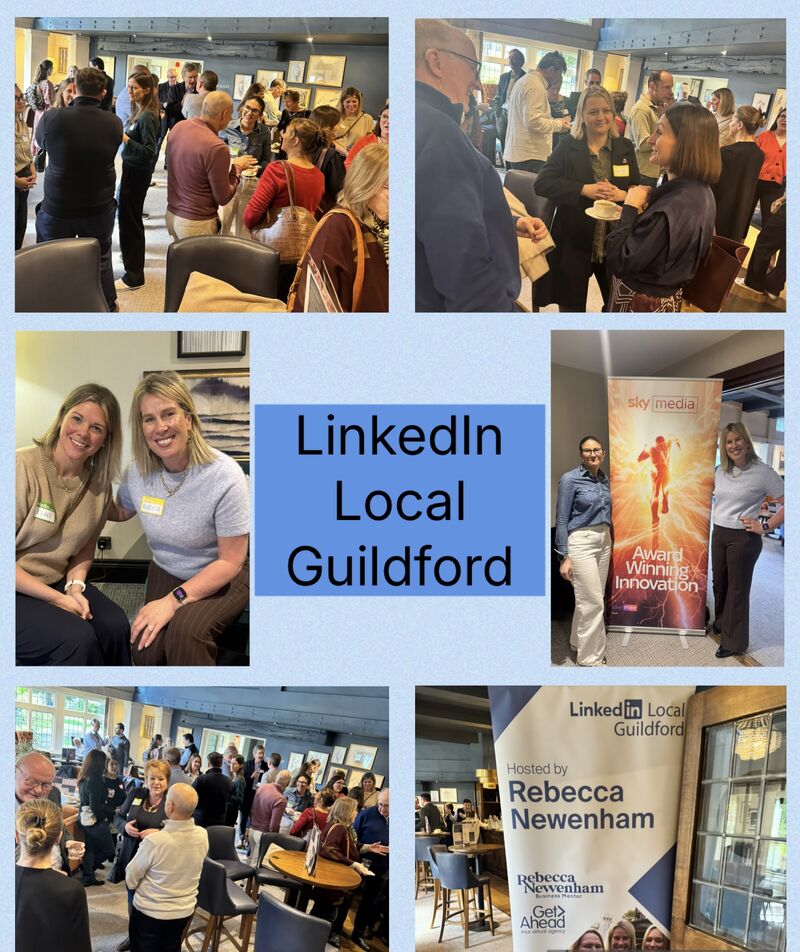
A collage of  a recent LinkedIn Local meeting in Guildford

Networking is about giving first

The most effective networkers are rarely the ones trying to sell the hardest. Instead, they are the people who focus on helping others.

Making introductions. Sharing ideas. Offering advice. Connecting people who might benefit from meeting.

Over time, that generosity has a way of coming back around.

Building stronger businesses together

For me, networking has never been a โ€œmarketing tacticโ€. Itโ€™s simply part of how business should work.

Businesses grow faster when people collaborate.
Communities are stronger when businesses support each other.
And opportunities appear when we take the time to build genuine relationships.

At Get Ahead, that philosophy runs right through our organisation. Our Regional Directors are deeply connected within their local business communities across the UK, building relationships that help businesses access the support they need to grow.

Because when strong networks come together, great things happen.

Why not experience it for yourself?

Get Connected - Get Ahead in association with Metro Bank

Across our regions, we host and support a range of networking events, including Get Connected, which we frequently host in partnership with Metro Bank, as well as a growing number of LinkedIn Local gatherings. These events create opportunities for business owners and professionals to share ideas, build relationships and support each otherโ€™s growth.

If youโ€™re curious, or even a little sceptical, about the impact networking can have, the best way to understand it is simply to experience what that community feels like in practice.

Take a look at our event calendar to find a meeting near you. Youโ€™ll always find a warm welcome and a room full of people who understand the highs and lows of running a business.

Because in the end, businesses – and all of us personally – grow through relationships.

Lifestyle Manager Services: Support for Busy Households and Families

For many busy professionals, there comes a point when the logistics of running a home start to compete with everything else.

Careers are demanding. Family life is full. Weekends disappear into lists of things that need organising; suppliers to call, deliveries to coordinate, properties to check, plans to arrange.

None of these things is particularly difficult. But together, they take time, attention and mental energy.

Thatโ€™s the moment when many people start to ask a simple question:

โ€œIs there someone who could just take care of this for me?โ€

At Get Ahead, weโ€™ve been hearing this question more and more from clients and contacts, people who are successful in their careers but simply donโ€™t have the time or desire to manage every practical detail of their home and lifestyle.

Thatโ€™s why weโ€™ve launched our new Lifestyle Manager service, designed to provide trusted support with the practical logistics that keep a home and family life running smoothly.

A Trusted Partner for the Practical Details

Our Lifestyle Manager service provides a single, trusted point of contact to oversee the practical details that sit outside the workplace but still need to run smoothly.

That might include:

  • Coordinating trades and household suppliers
  • Arranging property checks when youโ€™re travelling
  • Preparing your home for guests or returning from a trip
  • Managing deliveries, access and logistics
  • Organising special occasions or family gatherings

In short, itโ€™s about making sure the things that need to happen in the background actually happen, reliably, professionally and without you having to think about them.

Supporting Busy Family Lives

For many people, this stage of life also comes with an additional layer of responsibility.

Theyโ€™re supporting children with increasingly busy lives, while also helping ageing parents who may need a little more practical coordination and support.

This stage of life is often described as the sandwich generation, balancing the needs of two generations while managing demanding careers and households of their own. Many professionals recognise this picture: work commitments, childrenโ€™s activities and supporting ageing parents, all while trying to keep the practical details of their own homes running smoothly.

Having a trusted person who can quietly take care of some of the day-to-day logistics can make a real difference.

Thatโ€™s exactly what our Lifestyle Manager service is designed to provide.

Professional Support, Delivered the Get Ahead Way

One of the things that makes this service different is that itโ€™s delivered as part of the Get Ahead network.

For years, Get Ahead has supported businesses with flexible access to experienced professionals across areas such as marketing, HR, operations and administration. Clients trust us because of the quality of the people behind the service.

Our Lifestyle Manager offering builds on that same approach.

You gain a dedicated, trusted partner, supported by the wider Get Ahead team when additional expertise is needed.

Itโ€™s discreet, dependable support, designed to make life easier.

More Time for the Things That Matter

Ultimately, this service exists for one reason: to give people time back.

Time to focus on work when work is demanding.
Time to spend with family and friends.
Time to enjoy your home rather than manage it.

As we like to say:

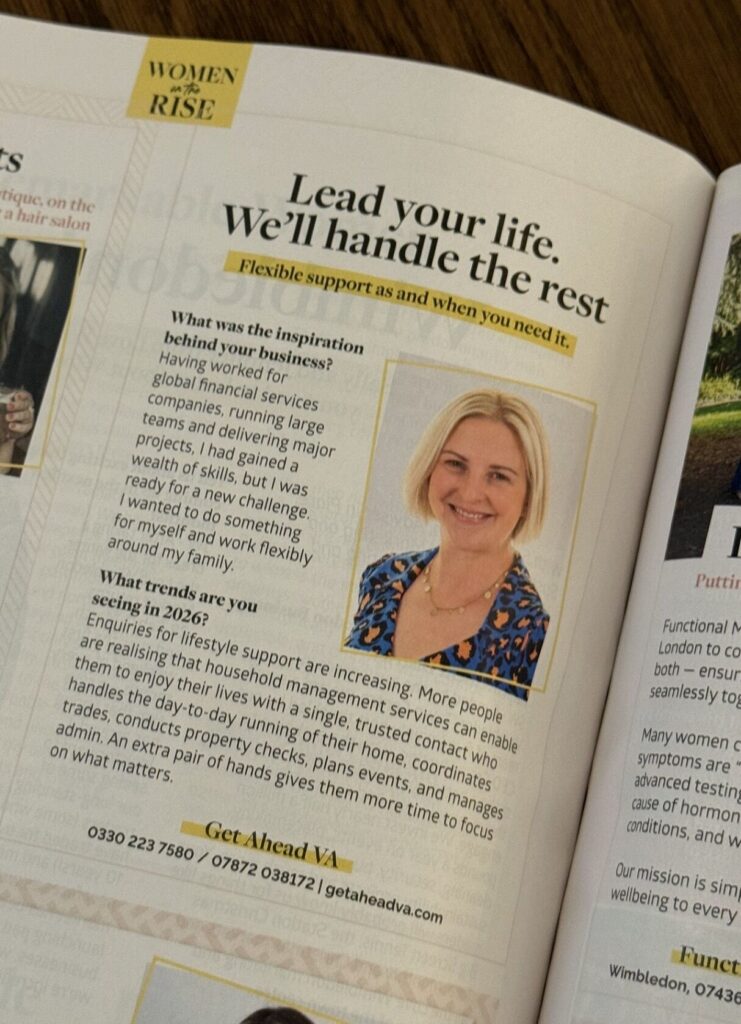
Lead your life. We’ll handle the rest.

Or put another way:

The staff you donโ€™t see. The difference you do.

Curious Whether This Could Help?

Many people only start exploring this kind of support when things feel particularly busy or stretched.

But often the biggest benefit comes from having trusted help in place before things reach that point.

If youโ€™d like to understand how the Lifestyle Manager service works, or simply explore whether it might be useful for your household, Iโ€™d be very happy to have an informal conversation. You can book a call with me using this link, or email me at natasha.doran@getaheadva.com. I look forward to speaking with you.

And a final thank-you to Time & Leisure Magazine, which recently featured this piece. It was lovely to see it in print for the first time.

Workplace Harassment and EDI: What Employers Must Know in 2026

Creating an inclusive workplace is no longer simply good practice, it is a legal and commercial necessity. With the introduction of the Worker Protection Act 2024, employers now have a proactive duty to prevent sexual harassment, not just respond when issues arise.

For SME leaders, this means understanding how EDI principles, workplace behaviour, and legal compliance intersect, and putting practical measures in place to reduce risk, protect employees, and safeguard reputation.

An inclusive culture doesnโ€™t happen by accident. It is built through everyday decisions, clear policies, confident leadership, and a shared understanding of acceptable behaviour.

What Does EDI Mean in the Workplace? 

Inclusion is often talked about in abstract terms, but in reality itโ€™s built through everyday behaviours. It means respecting differences, minimising assumptions, and creating an environment where people can contribute fully without fear of judgement. 

Our โ€œframes of referenceโ€, which are the experiences that shape how we see the world, differ widely across generations, backgrounds, and roles. Recognising this helps us understand why colleagues may interpret the same situation differently, and why empathy matters. 

Inclusive workplaces tend to share the same characteristics: 

  • Respectful communication 
  • Fair decisionmaking 
  • Active listening 
  • Equal access to opportunities 
  • Awareness of how our behaviour impacts others 

The Equality Act 2010 โ€“ Key Legal Duties for Employers 

The Equality Act 2010 protects people from discrimination based on nine protected characteristics, including age, disability, race, sex, religion, and sexual orientation. It also defines four types of unlawful behaviour: 

  • Direct discrimination – treating someone less favourably because of a protected characteristic. 
  • Indirect discrimination – a rule that applies to everyone but disadvantages a particular group. 
  • Harassment โ€“ unwanted conduct that violates dignity or creates a hostile environment. 
  • Victimisation –  unfair treatment because someone raised or supported a complaint. 

These definitions matter because they help us recognise when behaviour crosses a line, even when itโ€™s subtle or unintended. 

Understanding Workplace Bias and Its Impact 

Bias is an automatic preference or assumption that influences how we think and act. It often shows up in small ways: who we listen to, who we interrupt, who we see as โ€œleadership material,โ€ or who we assume will โ€œfit in.โ€ 

Common examples include: 

  • Affinity bias – favouring people who feel similar to us. 
  • Gender role assumptions – expecting women to take notes or organise admin tasks. 
  • Age bias – assuming older colleagues will struggle with technology. 

Bias affects who gets opportunities, who feels heard, and who feels excluded. Left unchallenged, it can damage morale and lead to discrimination claims. 

What Counts as Harassment and Sexual Harassment? 

Harassment isnโ€™t always loud or obvious. It can be subtle, repetitive, or disguised as humour. Examples include: 

  • Comments about appearance 
  • Sexualised jokes or innuendo 
  • Mocking disability or speech patterns 
  • Persistent unwanted attention 
  • โ€œItโ€™s just banterโ€ that causes discomfort 

Sexual harassment can be verbal, nonverbal, physical, or online. And importantly, it doesnโ€™t need to be intentional to be unlawful. 

For client-facing teams, the law also covers harassment by clients, contractors, and members of the public. 

The Worker Protection Act 2024 โ€“ What Has Changed? 

From 2024 onwards, employers must take reasonable steps to prevent sexual harassment and not simply respond after incidents. This includes: 

  • Training 
  • Clear reporting routes 
  • Robust policies 
  • Following up concerns 
  • Managing client behaviour 

This shift reflects a wider cultural expectation: prevention is everyoneโ€™s responsibility. 

Real Tribunal Cases and the Cost of Inaction

Recent tribunal cases show the cost of ignoring inappropriate behaviour. In one example, an 18 year old Lidl employee won ยฃ50,884 after persistent sexualised remarks from her manager. In another, an employer was held liable for failing to act on repeated inappropriate comments, resulting in over ยฃ15,000 in compensation. 

The message is clear: failing to intervene isnโ€™t just a cultural risk, it is also a legal and financial one. 

The Role of Bystander Intervention in Prevention 

Everyone has a role in shaping workplace culture. Small actions can prevent escalation. Four practical approaches include: 

  • Direct โ€“ calmly addressing behaviour in the moment. 
  • Distract โ€“ interrupting or redirecting the situation. 
  • Delegate โ€“ involving someone with authority. 
  • Delay โ€“ checking in with the affected person afterwards. 

Intervention doesnโ€™t have to be confrontational. It just has to be intentional. 

Creating a Safe, Inclusive Workplace Culture

A healthy workplace depends on: 

  • Clear routes for raising concerns 
  • No fear of retaliation 
  • Confidentiality 
  • Consistent handling of issues 

Policies matter, but culture is built through everyday choices. Inclusion is everyoneโ€™s responsibility, and small changes create big impact. 

This session forms part of our wider Workplace Culture and Leadership Training programme, designed specifically for growing SMEs who want to combine compliance with commercial strength.

Speak to us about a bespoke approach for your organisation – book a call with Hazel.