The Power of Networking in Business

When people talk about networking, the image that often comes to mind is a busy room full of people exchanging business cards and delivering rehearsed elevator pitches.

But in my experience, real networking is something quite different.

It’s not about selling. It’s about connecting.

And over the years, networking has been one of the most powerful forces behind the growth of Get Ahead.

Networking is about relationships, not transactions

When I started Get Ahead, I quickly realised that building a business isn’t something you do alone. Every entrepreneur needs a network of people around them; people who offer advice, share opportunities, introduce contacts, and provide support when challenges arise.

Some of the most valuable relationships I’ve built started with a simple conversation at a networking event.

Not a pitch. Not a sales conversation. Just two people talking about their businesses and how they might help each other.

Those relationships have often turned into collaborations, referrals, partnerships and friendships that last for years.

The hidden value of being visible

One of the biggest benefits of networking is simply being present.

People work with people they know, like and trust. That trust rarely comes from a single interaction. It builds gradually as people see you showing up, contributing and supporting others in the business community.

Networking helps create that visibility.

Whether it’s attending events, hosting roundtables, supporting local business groups or introducing others within your network. Every interaction strengthens your reputation.

The power of community

Something I’ve always loved about the SME community is how collaborative it can be. Business owners understand the ups and downs of running a company, and there’s a real willingness to support each other.

At Get Ahead we see this every day. Many of our client relationships and regional partnerships have grown through local business networks and community events.

When businesses support each other, everyone benefits.
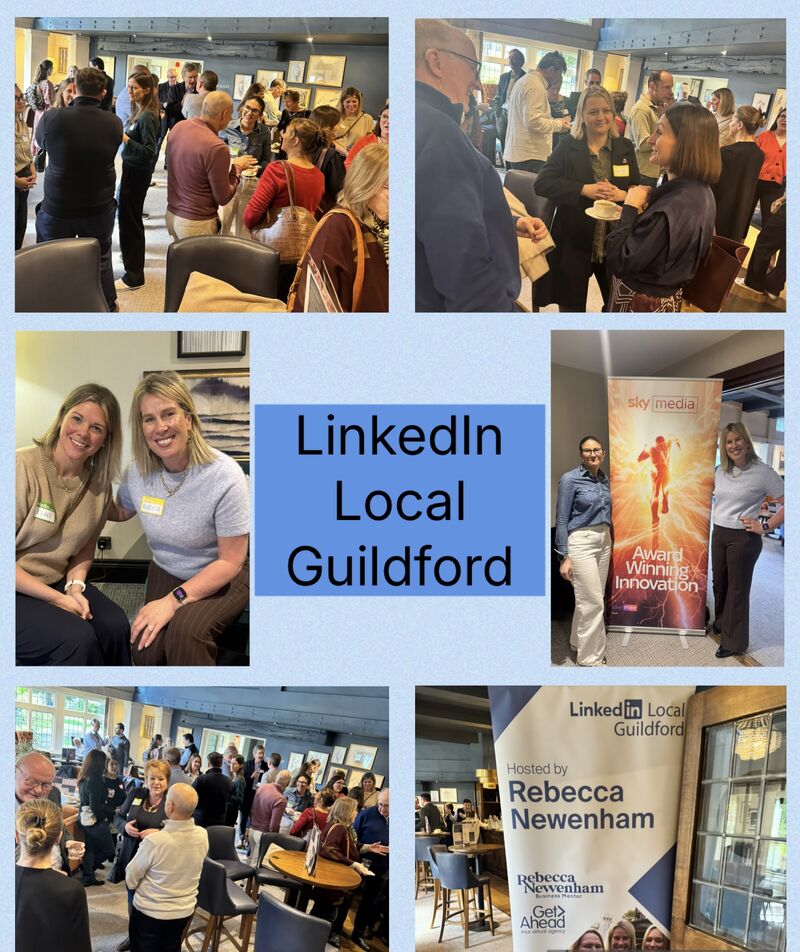
A collage of  a recent LinkedIn Local meeting in Guildford

Networking is about giving first

The most effective networkers are rarely the ones trying to sell the hardest. Instead, they are the people who focus on helping others.

Making introductions. Sharing ideas. Offering advice. Connecting people who might benefit from meeting.

Over time, that generosity has a way of coming back around.

Building stronger businesses together

For me, networking has never been a “marketing tactic”. It’s simply part of how business should work.

Businesses grow faster when people collaborate.
Communities are stronger when businesses support each other.
And opportunities appear when we take the time to build genuine relationships.

At Get Ahead, that philosophy runs right through our organisation. Our Regional Directors are deeply connected within their local business communities across the UK, building relationships that help businesses access the support they need to grow.

Because when strong networks come together, great things happen.

Why not experience it for yourself?

Get Connected - Get Ahead in association with Metro Bank

Across our regions, we host and support a range of networking events, including Get Connected, which we frequently host in partnership with Metro Bank, as well as a growing number of LinkedIn Local gatherings. These events create opportunities for business owners and professionals to share ideas, build relationships and support each other’s growth.

If you’re curious, or even a little sceptical, about the impact networking can have, the best way to understand it is simply to experience what that community feels like in practice.

Take a look at our event calendar to find a meeting near you. You’ll always find a warm welcome and a room full of people who understand the highs and lows of running a business.

Because in the end, businesses – and all of us personally – grow through relationships.

Workplace Harassment and EDI: What Employers Must Know in 2026

Creating an inclusive workplace is no longer simply good practice, it is a legal and commercial necessity. With the introduction of the Worker Protection Act 2024, employers now have a proactive duty to prevent sexual harassment, not just respond when issues arise.

For SME leaders, this means understanding how EDI principles, workplace behaviour, and legal compliance intersect, and putting practical measures in place to reduce risk, protect employees, and safeguard reputation.

An inclusive culture doesn’t happen by accident. It is built through everyday decisions, clear policies, confident leadership, and a shared understanding of acceptable behaviour.

What Does EDI Mean in the Workplace? 

Inclusion is often talked about in abstract terms, but in reality it’s built through everyday behaviours. It means respecting differences, minimising assumptions, and creating an environment where people can contribute fully without fear of judgement. 

Our “frames of reference”, which are the experiences that shape how we see the world, differ widely across generations, backgrounds, and roles. Recognising this helps us understand why colleagues may interpret the same situation differently, and why empathy matters. 

Inclusive workplaces tend to share the same characteristics: 

  • Respectful communication 
  • Fair decisionmaking 
  • Active listening 
  • Equal access to opportunities 
  • Awareness of how our behaviour impacts others 

The Equality Act 2010 – Key Legal Duties for Employers 

The Equality Act 2010 protects people from discrimination based on nine protected characteristics, including age, disability, race, sex, religion, and sexual orientation. It also defines four types of unlawful behaviour: 

  • Direct discrimination – treating someone less favourably because of a protected characteristic. 
  • Indirect discrimination – a rule that applies to everyone but disadvantages a particular group. 
  • Harassment – unwanted conduct that violates dignity or creates a hostile environment. 
  • Victimisation –  unfair treatment because someone raised or supported a complaint. 

These definitions matter because they help us recognise when behaviour crosses a line, even when it’s subtle or unintended. 

Understanding Workplace Bias and Its Impact 

Bias is an automatic preference or assumption that influences how we think and act. It often shows up in small ways: who we listen to, who we interrupt, who we see as “leadership material,” or who we assume will “fit in.” 

Common examples include: 

  • Affinity bias – favouring people who feel similar to us. 
  • Gender role assumptions – expecting women to take notes or organise admin tasks. 
  • Age bias – assuming older colleagues will struggle with technology. 

Bias affects who gets opportunities, who feels heard, and who feels excluded. Left unchallenged, it can damage morale and lead to discrimination claims. 

What Counts as Harassment and Sexual Harassment? 

Harassment isn’t always loud or obvious. It can be subtle, repetitive, or disguised as humour. Examples include: 

  • Comments about appearance 
  • Sexualised jokes or innuendo 
  • Mocking disability or speech patterns 
  • Persistent unwanted attention 
  • “It’s just banter” that causes discomfort 

Sexual harassment can be verbal, nonverbal, physical, or online. And importantly, it doesn’t need to be intentional to be unlawful. 

For client-facing teams, the law also covers harassment by clients, contractors, and members of the public. 

The Worker Protection Act 2024 – What Has Changed? 

From 2024 onwards, employers must take reasonable steps to prevent sexual harassment and not simply respond after incidents. This includes: 

  • Training 
  • Clear reporting routes 
  • Robust policies 
  • Following up concerns 
  • Managing client behaviour 

This shift reflects a wider cultural expectation: prevention is everyone’s responsibility. 

Real Tribunal Cases and the Cost of Inaction

Recent tribunal cases show the cost of ignoring inappropriate behaviour. In one example, an 18 year old Lidl employee won £50,884 after persistent sexualised remarks from her manager. In another, an employer was held liable for failing to act on repeated inappropriate comments, resulting in over £15,000 in compensation. 

The message is clear: failing to intervene isn’t just a cultural risk, it is also a legal and financial one. 

The Role of Bystander Intervention in Prevention 

Everyone has a role in shaping workplace culture. Small actions can prevent escalation. Four practical approaches include: 

  • Direct – calmly addressing behaviour in the moment. 
  • Distract – interrupting or redirecting the situation. 
  • Delegate – involving someone with authority. 
  • Delay – checking in with the affected person afterwards. 

Intervention doesn’t have to be confrontational. It just has to be intentional. 

Creating a Safe, Inclusive Workplace Culture

A healthy workplace depends on: 

  • Clear routes for raising concerns 
  • No fear of retaliation 
  • Confidentiality 
  • Consistent handling of issues 

Policies matter, but culture is built through everyday choices. Inclusion is everyone’s responsibility, and small changes create big impact. 

This session forms part of our wider Workplace Culture and Leadership Training programme, designed specifically for growing SMEs who want to combine compliance with commercial strength.

Speak to us about a bespoke approach for your organisation – book a call with Hazel.

Many leaders can list what their marketer does. Far fewer can explain which activities directly support growth. 

When clarity is missing, recruitment becomes guesswork. 

Activity vs impact 

Marketing output is easy to see: 

  • Social posts 
  • Campaigns 
  • Content 

Marketing impact is harder to measure without proper review. 

Using change as an opportunity 

Periods of change allow businesses to: 

  • Rebuild marketing around outcomes 
  • Align skills to growth goals 
  • Improve ROI from limited budgets 

The result is not just a better hire but a more effective marketing function. 

If this touches a nerve, you can read more here or contact us today to find out more. 

Many SMEs use inboxes, ad-hoc notes or even try to rely on their memory to track holidays, sickness or employee details, and that’s when problems start. 

But a simple HR tracker can dramatically improve your admin, compliance and employee experience. 

Why a tracker matters 

1. No more searching through emails 

Everything is recorded in one place. 

2. Prevents mistakes 

Double-booked holidays, missed probation reviews, forgotten training dates… 

3. Supports better conversations 

Clear data means better discussions around performance, attendance or wellbeing. 

4. Shows patterns early 

Spotting trends early helps you manage issues proactively. 

5. Makes you look (and feel) more professional 

Employees appreciate organised systems. 

What should be included? 

A good tracker should include: 

  • Holiday balances 
  • Sickness & absence 
  • Start dates 
  • End-of-probation dates 
  • Training 
  • Appraisals 
  • Next-of-kin information 

You’ll find all of this in the template included in the HR Confidence package. 

Want a tracker that’s ready to use? 

Explore HR Confidence 


Google is great for recipes and DIY hacks, but not HR advice. 

Here’s why. 

1. HR law changes constantly 

Blogs from 2017 won’t reflect today’s legislation. 

2. You don’t know the source 

Some articles are written by non-experts. 

3. Generic advice doesn’t fit your situation 

HR is context-dependent, business size, history, contracts, policies… 

4. Bad advice can be costly 

A mishandled grievance or dismissal can lead to expensive claims. 

5. You waste time searching 

A 10-minute call with an HR Partner is often faster than an hour of Googling. 

Get trusted answers with the HR Partner package.  

Your onboarding and offboarding processes shape how employees feel about your business, from day one to their last (and beyond). 

Here’s why they matter. 

1. A great onboarding experience boosts productivity 

A great induction process, clear expectations, access to tools, and a warm welcome mean: 

  • Faster ramp-up time 
  • Fewer mistakes 
  • Higher confidence 

2. Poor onboarding creates risk 

Common issues include: 

  • No contracts signed 
  • Missing documents 
  • No policy awareness 
  • Unclear expectations 
  • Lack of system access 

These create confusion and, at times, even legal exposure. 

3. A structured leaver process protects your business 

Without a process, and an exit checklist, things get missed: 

  • Equipment return 
  • Access removal 
  • Final payments 
  • References 
  • Knowledge transfer 

A leaver leaving with system access is a serious risk. 

4. Small businesses benefit the most 

With small teams, the experience of one person has a huge impact on culture. 

That’s why the HR Confidence package includes a full review of your onboarding and leaver processes. And why HR Assist can manage your monthly admin for you.  

If your business is growing and you’ve hired a few employees, an HR audit is one of the smartest investments you can make. 

Here’s what an audit is, and why it matters. 

What is an HR Audit? 

It’s a structured review of your HR documents, processes and compliance. For SMEs, it usually includes: 

  • Employment contracts 
  • Policies & handbook 
  • Onboarding and offboarding 
  • HR admin (tracking holidays, absences) 
  • Record keeping 

Why do small businesses need one? 

1. Laws change, and templates quickly become outdated 

A contract from 2019 may no longer meet current requirements. 

2. Policies drift away from reality 

Businesses evolve, but policies often stay frozen. 

3. Growth exposes gaps 

What worked for 3 employees may not work for 12. 

4. It prevents costly mistakes 

Issues like grievances or disputes are much easier to manage when your documents are strong and compliant. 

What happens afterwards? 

You get: 

  • Updated, compliant HR documents 
  • Clear processes 
  • Confidence that you’re doing things right 
  • A more professional experience for employees 

Exactly what the HR Confidence package delivers.  

Ready for clarity and compliance? 

Explore HR Confidence 

Hiring your first employee is an exciting step, but there are a few legal and practical things you must do before they start. Here’s the simple checklist small businesses rely on. 

1. Confirm the job details 

Before you recruit, be clear on: 

  • Job title 
  • Hours 
  • Pay 
  • Responsibilities 
  • Location or hybrid terms 

This clarity helps attract the right candidate and reduces future misunderstandings. 

2. Do your right-to-work checks 

This is a legal requirement for all employers. 

Make sure you copy and securely store the documents. 

3. Issue an offer letter 

Short, simple, professional, this confirms key details like: 

  • Salary 
  • Hours 
  • Start date 
  • Conditions of offer 

4. Prepare the employment contract 

You must issue this on or before day one of employment. 

A compliant contract protects both you and your new hire, setting clear expectations from the start. 

5. Share your employee handbook 

Give your new employee the essential policies, such as: 

  • Sickness 
  • Holidays 
  • Conduct 
  • Data protection 
  • Grievance and disciplinary 

Even small businesses need these. 

6. Set up payroll 

Register the employee with HMRC and organise payroll software or support. 

7. Create a new starter checklist 

This helps you remember: 

  • Emergency contact details 
  • Equipment access 
  • System logins 
  • Induction meeting 
  • Policy sign-offs 

You’ll find one included in HR Foundations.  

Ready to hire with confidence? 

Our HR Foundations package includes all the templates and documents you need, plus a consultation to guide you. 

See HR Foundations 

Book a free HR call 

You don’t need HR advice every day, but when you do, you really need it. Here are the moments it’s essential to call an expert. 

1. When an employee raises a grievance 

Even informal complaints need careful handling. 

2. When you’re unsure how a policy applies 

Sickness, leave, flexible working… 

One wrong interpretation can create inconsistency. 

3. When someone’s performance is slipping 

You need to handle this carefully, fairly, and legally. 

4. When conduct becomes an issue 

Lateness, behaviour, attitude? Get advice early. 

5. When someone requests adjustments 

You’ll want to balance support with clear boundaries. 

6. When an employee relationship feels “tricky” 

A neutral expert helps you respond calmly and objectively. 

7. When you feel unsure 

If you’re thinking, “Should I check this with HR?”, the answer is yes. 

The HR Partner package gives you access to experienced HR support in 15-minute segments, so you get exactly the help you need, when you need it.  

When you hear “employee handbook” you might imagine a heavy folder collecting dust on a shelf. But for small and growing businesses, your handbook doesn’t need to be complicated, in fact, it’s better if it isn’t. 

A simple, clear handbook gives your employees clarity and protects your business. Here’s why getting it right matters more than making it long. 

1. A Simple Handbook Reduces Confusion 

Your employees should be able to understand quickly: 

  • How holidays work 
  • What to do when they’re sick 
  • How their data is handled 
  • What standards of behaviour are expected 

If it requires an HR degree to interpret, it’s not helpful. 

2. It Makes Managing People Easier 

When small businesses don’t have policies, every decision becomes a “one-off”. That leads to inconsistency, and inconsistency leads to complaints. 

A clear handbook ensures: 

  • Everyone knows the rules 
  • You have something to refer to when issues arise 
  • You can handle problems fairly and confidently 

3. It Protects You Legally 

Some policies are required by law, including: 

  • Disciplinary and grievance 
  • Health and safety 


  • Data protection/privacy 

Even small teams need these written down. If something goes wrong, having them in place can significantly reduce risk. 

4. It Helps New Starters Settle in Faster 

A new employee wants to feel confident and informed. Your handbook gives them all the basics in one place, making their first week smoother and less stressful. 

5. It Doesn’t Need to Be Long 

Your handbook should be: 

  • Clear 
  • Concise 
  • Easy to navigate 
  • Focused on the essentials 

That’s why the HR Foundations package includes a simple, practical handbook designed for small businesses, with all the core policies you need, and none of the fluff.  

Need help creating or updating yours? 

We keep things human, friendly and flexible, exactly how HR support should feel. 

Explore HR Foundations 

Book a free consultation