Losing my AI blinkers
By Kristy Roff
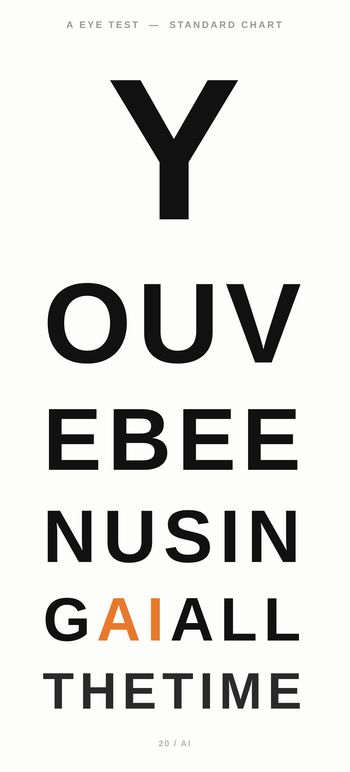
Ask most people when they started using AI, and they’ll suggest it was fairly recently, usually somewhere around when ChatGPT became the thing everyone at every social gathering wanted to talk about. I’d have given you the same answer, but it turns out it was wrong.
I hadn’t appreciated I was already comfortably using AI
I’ve spent enough time around technology, without ever being a techie myself, to know that solutions and products and acronyms get relabelled constantly, often referring to exactly the same thing under a different name. I’m still not sure if that was complete naivety on my part or simply a lack of awareness of what these different tools and services actually were. Probably a bit of both. What I hadn’t appreciated was that AI had already quietly become part of my life long before I consciously decided to “use AI” at all. Siri answering a quick question in the car. Alexa setting a timer while my hands were full. The autoreply suggestions that finish half my emails before I’ve decided what I actually want to say. Even the design suggestions PowerPoint offered when I was preparing presentations.
All of it AI. None of it registering as AI at the time.
It’s hard, looking back, to pin down exactly when “before AI” was. It’s probably a couple of years ago now that I first knowingly turned to it, rather than just benefiting from it in the background, but the pace that it’s integrated into working practices, makes that feel like a much longer time ago than it actually is.
The first thing I knowingly tried was ChatGPT, because it was the tool everyone was talking about. I dabbled with it, used it, challenged it, and still do. Early on, it frustrated me more than it helped. I’d ask for suggestions, and what came back wasn’t remotely in line with what I was thinking, so I’d ask again. More than once it felt like it didn’t like my corrections, or the fact I wasn’t satisfied with the output. A regenerated go would come back quicker and shorter, seemingly pi$$ed that I hadn’t liked its first attempt. I know that’s not really what was happening. But it’s exactly how it felt, and I don’t think I’m the only one who’s had that experience.
So it wasn’t with a grand decision to embrace new technology, but with the slow realisation that I’d been living alongside it for years without truly acknowledging that I was subconsciously embracing the tools that worked for me to make life just a little bit easier. Followed by the slightly bumpy process of learning to use it properly once I did. I want to be honest about that whole process here: the point where it properly rattled me, what I’ve learned to trust it with, and what I never will, and where I’ve landed now that the initial cautiousness has worn off.
The moment I worried AI would give me away
Once I’d got past some of the frustrations, (talking back at me like I’d offended it), I found something in AI that was so refreshing to me: a real second pair of eyes on my own thinking, rather than interrupting someone else or waiting on their reliable feedback. But it took me longer than I’d like to admit to work out why it only helped sometimes.
My Mum always used to say to me when I was growing up, “you only get out what you put in.” I heard it about school work, hobbies, about tidying my room, friendships. I did not expect to hear it echo quite so clearly in my head while typing prompts into my new best mate AI tool twenty-odd years later, but there it was. The quality of what came back depended entirely on how clear and specific I was about what I actually wanted. Vague in, vague out. The tool wasn’t the variable. I was.
You only get out what you put in.
That’s been the most useful learning on its own, and in a practical sense it still is. But still, I was noticing the first iterations were annoying me further, with the noticeable fingerprints everywhere in what it produced. The over-eager emojis. The elongated dashes AI seems to reach for constantly. Small things, but obvious once you know to look for them
And in my noticing that, especially on other content I was consuming, came a real worry that if I used AI to help shape my content, my audience, the people who follow what I write because they trust it’s actually me, would spot those tells and start wondering how much of “me” was still in there. I run a business built on people believing what I tell them, so that element of doubt crept in and I wasn’t comfortable with taking the risk.
So, quietly, my enthusiasm for it cooled. I pulled back from anything client or audience facing and redirected it somewhere that relied less on ‘me’ when generating the output. Data. Numbers. Research. A lot of people know I have always loved Excel, in a bit of a geeky way, so double-checking pricing calculations, or getting help on formulas “help” function couldn’t cope with, felt like a solid way to embrace AI, improve efficiency and to gain trust in the process.
This marked a real shift in how I thought about AI: not as a shortcut to lean on without thinking, but as something that needs real judgement applied to it, and to sanity check my own thinking.
What I’ll trust AI with, and what I won’t
By the time my reservations had eased, I’d recognised that the more useful question is what I’m actually prepared to trust AI with, rather than ‘should I use AI’.
The answer came partly from getting caught out. More than once, I’ve seen incorrect or unreliable outputs with a date wrong, or a figure that didn’t match what I knew to be true, sitting right in the middle of something that mattered. Nothing catastrophic, because I always check. But enough to teach me, firmly, that AI is not something I can hand full confidence to. It’s excellent for polishing, for proofreading, for giving me a starting point when I’m staring at a blank page. It is not something I sign off without reading properly first.
That same caution is mirrored by some of my own clients,Some of them want their Virtual Expert nowhere near AI when it comes to writing copy or creating content. They want what lands in front of their audience to be real, unmistakably them, and they see AI-flavoured content as the fastest way to undermine that. I understand that completely, because it’s close to the exact worry I’ve felt and described.
Others take the opposite view entirely. If a Virtual Expert who knows how to use AI well can complete a task in a quarter of the time it would take without it, that’s not a shortcut to them, it’s more value delivered, more capacity freed up, more actually gets done. The clients who think this way tend to be the ones already looking hardest at sustainable, innovative ways to grow, and AI is simply one more tool in that thinking rather than something to be nervous of.
Neither view is wrong. What’s interesting is that both are making the same judgement I make myself, just landing in different places: where does AI help, and where does it get in the way of the thing you’re actually trying to protect?
Part of what makes that judgement easier, for me, is being able to spot AI content that’s crossed the line into generic. You’ll have seen the the restaurant offers that turn up in every other Facebook post, with its Maccy D’s style menu that’s interchangeable and indistinguishable from a hundred others, that says nothing that actually differentiates the business behind them. That’s the version of AI I would actively avoid, and it’s a useful test I apply to my own output too.
If it could belong to absolutely anyone, it isn’t good enough.
None of this has stopped me finding real, everyday uses for it that I wouldn’t have predicted a year or two back. Proofreading, obviously. Scheduling. Bouncing around design ideas. And, more than I expected, research and searching, to the point where it’s now often my first go to over and above a Google search. It’s earned its place in my workflow, it just hasn’t earned my full trust, and I don’t think it should.
Be the one in the driving seat
After all of my naivety, doubt, learning and appreciation. I’m happy with how I find AI helps me, and now wonder what I’d do without it. There are things I’ve decided, firmly, to keep human (me!). A proper conversation still means picking up the phone or writing an email myself, even if that email gets a once-over for typos afterwards, which is really no different to the spellcheck and Grammarly habits I had long before any of this. Some things aren’t about efficiency. They’re about actually connecting with the person on the other end.
That’s part of why AI phone bots unsettle me more than almost anything else in this space. Some are obvious the moment they answer, which is almost fine, because at least you know where you stand. Others are impressively good enough now that I can’t always tell whether I’m talking to a person or not, and that ambiguity is the part I struggle with. If I don’t know who or what I’m talking to, something about the whole exchange feels wrong.
If someone starting out today asked me whether they should be worried or excited, I’d tell them to be excited. We’re living through an extraordinarily fast-moving period, and AI is there to be used to your advantage, not treated as a threat creeping up on you. It will never replace you as an individual. Your strengths, the ones that make you different from everyone else doing similar work, are exactly what will keep setting you apart, the same as they always have. AI doesn’t change that. If anything, it puts a sharper spotlight on it.
AI gives us access to intelligence most of us could never reach without it. We can now tap into that, quickly, on demand. Used well, that doesn’t make us lazy, it makes us sharper, provided we’re the ones deciding how to use it, not the other way round.
Driverless cars are already taking hold, and I’m not going to lie, I still get a flicker of nerves just using cruise control, so I can only imagine how my palms would sweat in a driverless car.
So my advice, Go at your own pace. Use what helps. Stay wary of what doesn’t.
Whatever you decide, make sure you’re still the one in the driving seat.
That’s the arc of this piece in a sentence: from not realising I was using AI at all, to worrying it might expose me, to learning exactly what I will and won’t hand over to it, and now, finally, to feeling settled in the driving seat.

Kristy Roff is a Get Ahead Regional Director with over 20 years’ experience in commercial, marketing and client relationship roles. Her career has spanned radio broadcasting – including senior positions at Global Radio – and a decade in B2B technology consultancy, giving her a broad understanding of the pressures that growing businesses face.
Kristy works closely with SME leadership teams to identify the right support and build flexible solutions that drive sustainable growth. Rather than simply placing Virtual Experts, she takes time to understand each client’s business, challenges and ambitions before carefully matching them with the right specialists from the Get Ahead network.
Her areas of expertise include marketing strategy, operational capacity, client relationship management and business support.